When you buy through links on our articles, Future and its syndication partners may earn a commission.

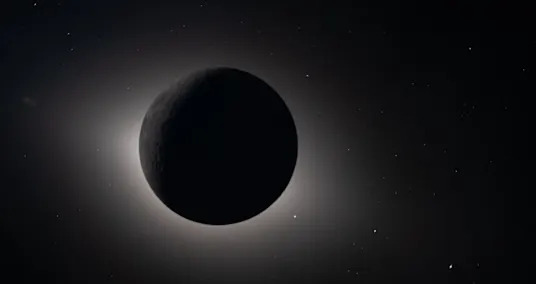
NASA's Artemis 2 astronauts have witnessed one of the rarest sights in spaceflight history — a total solar eclipse from beyond the moon.
The event unfolded yesterday (April 6) as the Orion spacecraft looped around the far side of the moon. This trajectory placed the crew in the right place at the right time to see the moon completely block the sun for about 53 minutes, which is far longer than the maximum period of totality for eclipses seen from Earth.
But it wasn't just the duration that made this eclipse extraordinary; it was the view.
NASA astronaut Victor Glover described the scene unfolding as the sun vanished behind the lunar disk.
"This continues to be unreal. The sun has gone behind the moon and the corona is still visible. It's bright and creates a halo almost around the entire moon," Glover said.
As darkness fell, another phenomenon quickly emerged. "When you get to the Earth side, the earthshine has already shown … almost seconds after the sun sets behind the moon, you can see earthshine," he added.
From Orion's windows, the crew was able to make out the faint glow of sunlight reflected off Earth, while stars and planets appeared in the background. The moon itself became a stark silhouette: "This black orb out in front of us," as Glover described it, edged by the glowing solar corona.

Though a rare sight, it's not the first time a solar eclipse has been viewed from lunar realms. The Apollo astronauts, who orbited the moon rather than flew by it (as Artemis 2 did), also saw solar eclipses, NASA's Kelsey Young, Artemis science flight operations lead, said during a press conference on Saturday (April 4).
The eclipse marks just one highlight in an already historic mission. Artemis 2 is the first crewed journey to the moon since Apollo 17 and has already set a new distance record for human spaceflight.
Following their impressive lunar flyby, the astronauts are now heading back toward Earth and are expected to splashdown on Friday (April 10) off the coast of San Diego.
LATEST POSTS
- 1
 Arctic sea ice hits lowest winter level as unprecedented heat hits smashes records all over Earth
 - 25 Great High-Mileage Electric Vehicles Of 2024
- 3NASA's Perseverance Mars rover could break the record for miles driven on another planet
- 4The largest sun of 2026 rises today as Earth draws closest to our parent star
- 5Figure out How to Really focus on Your Dental Inserts for Durable Outcomes



- Select Your Go-To Bluetooth Earphones
- The Fate of Mechanical technology: 5 Headways Forming Tomorrow
- Russia Establishing Long-Range Drone Bases In Belarus, Warns Ukraine
- When faith comes under fire: How Iran’s repression of religious minorities has increased
- How to watch Dick Clark’s New Year’s Rockin’ Eve with Ryan Seacrest: Start time, TV channel, performers and more
- The biggest black hole breakthroughs of 2025
- ‘Wu-Tang Forever: The Final Chamber’ tour — How to get tickets, presale times, concert dates and more
- Benin coup thwarted by loyalist troops, president tells nation
- 5 High Limit Outer Hard Drives For Information Stockpiling