When you buy through links on our articles, Future and its syndication partners may earn a commission.

The first test flight of Landspace's Zhuque-3 rocket ended in a fiery explosion after successfully reaching orbit.
Chinese company Landspace launched its 216-foot (66-meter) stainless steel Zhuque-3 rocket from the Jiuquan Satellite Launch Center in the Gobi Desert in northern China on Tuesday (Dec. 2). The reusable, methane-liquid-oxygen-powered rocket successfully placed its expendable second stage in orbit, according to a statement from Landspace.
But after making a successful reentry, the rocket's first stage booster appeared to lose an engine during its landing burn and catch fire before crashing into the ground in a spectacular explosion. "An anomaly occurred as the first stage approached the designated recovery zone. No personnel safety issues occurred," Landspace wrote on social media. The company is now investigating the anomaly to discover its root cause.
Despite the landing failure, Landspace is hailing the test flight as a success, adding in its social media post that "China's first rocket recovery attempt achieved its expected technical objectives." These include verifying Zhuque-3's recovery system, engine throttling, and attitude control. Stills from videos of the crash landing show that the first stage landed within just meters of its target landing zone.
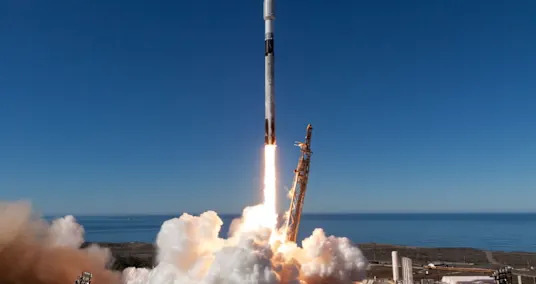
Zhuque-3 resembles SpaceX's dependable Falcon 9 rocket; both rockets feature a reusable first stage and an expendable upper stage and are powered by nine engines.
Zhuque-3's Tianque-12A engines are powered by a mixture of liquid methane and liquid oxygen (methalox), however, while the Falcon 9's Merlin engines burn liquid oxygen and rocket-grade kerosene.
Zhuque-3's payload capacity is similar to Falcon 9's as well, able to loft 40,350 pounds (18,300 kilograms) to low Earth orbit (LEO). Falcon 9, meanwhile, can send 50,265 pounds (22,800 kg) to LEO.
A Landspace previous rocket, Zhuque-2, became the world's first methane-powered rocket to reach orbit in July 2023. SpaceX's Raptor engine, which powers its Super Heavy booster and its Starship second stage vehicle, also burns liquid methane and liquid oxygen.
The Zhuque rockets are named for the vermillion bird from Chinese mythology that represents the fire element in Taoist five-element cosmological system.
LATEST POSTS
- 1
 Watch SpaceX launch 119 payloads to orbit from California early on March 30
 - 275% of Arab Israelis support Arab party joining government coalition post-war, survey reveals
- 3A hunger for new experiences Narratives: Motivating Travel and Experience
- 4An Extended period of Voyaging Carefully: the World with Reason
- 5Lockheed Martin opens new hypersonic weapons facility


- Instructions to Pick the Right Dental Expert for Teeth Substitution
- Israel's Druze use AI to present to UN testimonies of 'sexual terrorism' against Syrian Druze women
- Vehicle Lovers' Decision: Purchase A Reasonable Vehicle
- IDF carried out mission to locate former hostage Avera Mengistu a day before Oct. 7
- Dave Coulier reveals he has tongue cancer, his 2nd diagnosis in a year, after beating non-Hodgkin lymphoma
- Fabricated statement about Malaysian national exam top scorers stokes racial sentiment
- Investigating Design and Individual Style: Track down Your Remarkable Look
- 6 Popular Men's Aromas On the planet
- Launch pad damaged as Russian rocket blasts off for space station, agency says