When you buy through links on our articles, Future and its syndication partners may earn a commission.

For the first time in more than half a century, humanity is on its way to the moon.
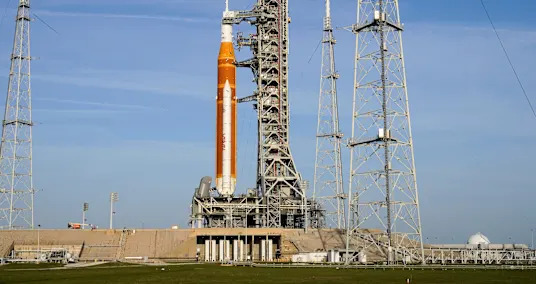
NASA's Artemis 2 mission began heading toward lunar realms on Thursday evening (April 2), after its Orion capsule aced an engine burn that took it out of Earth orbit.
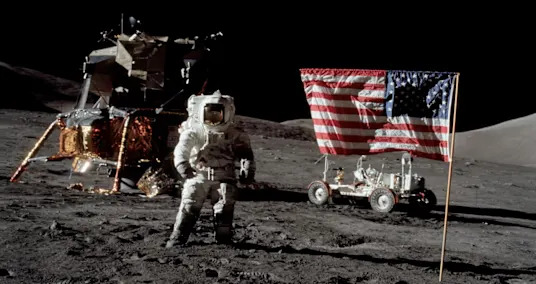
The four Artemis 2 astronauts are following a trail left by NASA's Apollo program, which last sent people to the moon in December 1972. This begs the question: Why has it taken us so long to go back?

A different time
The short answer is, times have changed. Apollo was a product of the Cold War space race. The U.S. believed that winning this race — by beating the Soviet Union to the moon — was a national security imperative.
The space race started in 1957, with a trio of "Sputnik moments." The first was the Soviet Union's surprise launch of Sputnik 1, the first-ever artificial satellite, on Oct. 4. A month later, Sputnik 2 sent the first animal to space — a poor pup named Laika, who did not survive the trip.
Then, in December of that year, the United States attempted to loft its first satellite, a tiny craft called Vanguard Test Vehicle 3. But the satellite's rocket exploded on live TV, adding to the United States' embarrassment and stoking fears that the nation had fallen behind its nuclear-armed rival in a very meaningful way.
Savvy people "understood the fact that, if they could put a satellite into orbit, that meant that there's a pretty good chance that they could drop a weapon pretty much wherever they wanted to," Ed Stewart, museum curator at the U.S. Space & Rocket Center, the official visitor center for NASA's Marshall Space Flight Center in Alabama, told Space.com.
In the U.S., decision-makers had generally regarded the Soviets as technologically challenged, he added. But the events of late 1957 shattered that perception and focused the attention of American politicians and military officials more sharply on the final frontier.
"So, we kind of turn space exploration into the proxy battleground for advancing these technologies that could just as easily have been used to drop military payloads as well as deliver people into space," Stewart said.
The Soviets won the first few laps of the space race; for instance, they also lofted the first person to the final frontier, Yuri Gagarin, in April 1961.
But putting boots on the moon became the finish line.
The timing of the space race was also key: It occurred as many newly independent nations, having thrown off the yoke of imperialism, were trying to find their way in the world.
Iran declared independence in 1946, for example, and India and Pakistan followed suit in 1947. Many African nations, including Ghana, Niger, Cameroon, Nigeria, Kenya and Tanzania, became free in the late 1950s or early 1960s.
The United States wanted these young nations on its side, as did the Soviets. And both superpowers viewed success in the space race as a way to get them on board.
"They realized that in human history, whenever two cultures have come up against each other, it's the one that has the better technology that usually ends up on the top of the heap," former NASA Chief Historian Roger Launius told Space.com.
Young nations like India were certainly aware of this as well. So, "Apollo was a demonstration of soft power — consciously, that was the reality of it," Launius said.
The importance of this demonstration was reflected in NASA's budget. During the height of the Apollo program, the space agency's funding was about 4.4% of the entire federal budget. These days, it's less than 0.4%.
The United States won the moon race, of course, putting Neil Armstrong and Buzz Aldrin down in the Sea of Tranquility on Apollo 11 in July 1969. Five more successful landing missions followed, but there was no momentum to carry on beyond Apollo 17 in 1972.
"I think a lot of folks were kind of [thinking], 'We did what JFK wanted us to do. We beat the Soviets. We're still the technological powerhouse of the world. Why do we need to go back?'" Stewart said.
The inauguration of President Richard Nixon in January 1969 also played a role, as his thinking on space exploration was quite different than the two leaders who preceded him, John F. Kennedy and Lyndon Johnson.
"President Nixon was really friendly on the idea of getting into a more affordable space program, and he really wanted the space shuttle concept to move forward," Stewart said. "So he put the kibosh on continued Apollo funding and started ramping up funding for the shuttle program."

The Apollo program was part of a geopolitical landscape that has been eroded away by the winds of change. The United States' great Cold War rival, the Soviet Union, doesn't even exist anymore; it collapsed in the early 1990s.
So that's why the United States stopped going to the moon, and why we didn't go back for decades — the powerful push to do so was gone.
"Motivation and catalysis are critical for anything that happens," said Frederic Bertley, president & CEO of the Center of Science and Industry, a museum and research center in Columbus, Ohio.
"Even though technology has advanced in so many ways in 50 years, [and] as broad as that advancement has been, or as big as that delta is, that delta doesn't approach geopolitical pressure," Bertley told Space.com.
Apollo was "like an amazing social experiment for humanity, to [see] what drives us to do stuff," he added.
Bertley takes a powerful lesson from that grand experiment, which put people on the moon using slide rules and chalkboard math just 12 years after the dawn of the space age: "If we're really motivated, we could solve everything."
A new moon race?
A new space rival has emerged recently — China, which is growing more ambitious and more accomplished in the final frontier with every passing day. And China has its eyes on the moon as well, stating that it wants to land astronauts there by 2030.
As a result, many power brokers in the U.S. — politicians, military officials and NASA leaders — have said we're in a new race to the moon. But the current competition with China is very different than the one that unfolded two generations ago, according to Launius.
"There is no comparison whatsoever," he said.
"The Soviet Union was a peer competitor with lots of nukes pointed at us. We had lots of nukes pointed at them, and both sides were sort of spring-loaded to use them," Launius said. "For those of us who grew up in that era, like myself, this was an existential threat. There's no way around that, at any moment, we believed that we could be demolished as a nation — maybe all the people on Earth wiped out with nuclear annihilation. And that [fear] just doesn't exist today."
The differences in eras are also apparent in the different goals of the Apollo and Artemis programs. Apollo was designed with a race in mind; it put boots in the gray dirt, but no roots. Artemis, by contrast, aims to establish a base near the lunar south pole, building knowledge and skills that will help humanity make the next giant leap — to Mars.
"This time, the goal is not flags and footprints," NASA Administrator Jared Isaacman said in late March, a week before Artemis 2 lifted off. "This time, the goal is to stay. America will never again give up the moon."

The only Lego Technic NASA Artemis Space Launch System Rocket, once built it can 'launch' thanks to the clever Technic engineering mechanisms inside. It stands 27.5-inches (70 cm) tall but is made from only 632 pieces, making this suitable for ages 9+, compared with the adult-oriented (and $260) static Lego Icons NASA Artemis Space Launch System (10341) model.
LATEST POSTS
- 1
 Hezbollah claims right to respond to killing of top commander
 - 2Bother Control Administrations for 2024: Decide for Your Home
- 3Iran war drives global fertilizer prices up, raising food cost fears
- 4From School Dropout to Example of overcoming adversity: My Excursion
- 5MacArthur Foundation awards $100M to outbreak surveillance network, a boost amid global health cuts





- We analyzed Philly street scenes and identified signs of gentrification using machine learning trained on longtime residents’ observations
- Cyprus: War-related tourism concerns and climate change efforts
- Catch the moon dancing with bright star Regulus tonight
- Moon rocket and weather are on NASA's side for the first astronaut launch in decades
- Turkey, Egypt, Qatar discuss second phase of Gaza ceasefire deal
- Minnesota jury says Johnson & Johnson owes $65.5 million to woman with cancer who used talcum powder
- 7 Fun Plans to Make Film Evenings Seriously Energizing (You'll Cherish #5!)
- Space Condos to Lift Your Metropolitan Living
- Presenting Nintendo's New Pastel Satisfaction Con Tones for Switch Gamers: 3 Upscale Choices