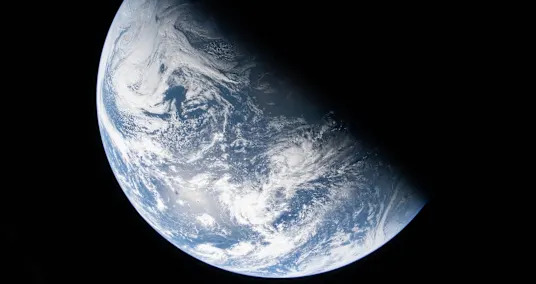
Now more than halfway to the moon, the Artemis II astronauts were toasted by Canada on Saturday as they prepared for their historic lunar fly-around to push deeper into space than even the Apollo astronauts.
The three Americans and one Canadian will reach their destination Monday, photographing the mysterious lunar far side as they zoom around. It's the first moonbound crew in more than 53 years, picking up where NASA’s Apollo program left off.
Artemis II was poised to set a distance record for humans, traveling more than 252,000 miles (400,000 kilometers) from Earth before hanging a U-turn behind the moon and heading home without stopping or entering lunar orbit. The record is currently held by Apollo 13.
The Canadian Space Agency celebrated the country’s role in the mission, speaking from Quebec with astronaut Jeremy Hansen as he headed toward his lunar rendezvous. Hansen is the first non-U.S. citizen to fly to the moon.
“Today he is making history for Canada," said Canadian Space Agency President Lisa Campbell. “As we watch him taking this bold step into the unknown, let his journey remind us that Canada’s future is written by those who dare to reach for more.”
In the live televised linkup, Hansen said he's already witnessed “extraordinary” views from NASA's Orion capsule.
Hansen, Reid Wiseman, Victor Glover and Christina Koch are the world's first lunar astronauts since Apollo 17's crew of three in 1972. Koch and Glover are the first female and first Black astronauts to the moon, respectively.
Their nearly 10-day mission — ending with a Pacific splashdown on April 10 — is the first step in NASA's bold plans for a sustainable moon base. The space agency is aiming for a moon landing by two astronauts near the lunar south pole in 2028.
___
The Associated Press Health and Science Department receives support from the Howard Hughes Medical Institute’s Department of Science Education and the Robert Wood Johnson Foundation. The AP is solely responsible for all content.
LATEST POSTS
- 1
 Most normal matter in the universe isn't found in planets, stars or galaxies – an astronomer explains where it's distributed
 - 2Can humans have babies in space? It may be harder than expected
- 3Beneficial Growing Conditions in West Africa Weigh on Cocoa Prices
- 4Heavy rain, floods kill at least 45 people in Afghanistan, Pakistan
- 56 Popular Ladies' Aromas On the planet




- AstraZeneca to invest $2 billion as part of US manufacturing push
- Investigating Remarkable Espresso Flavors: Upgrade Your Day to day Blend
- How will the universe end?
- Dominating the Remote Work Way of life: Individual Systems
- 5 Instructive Toy Brands for Youngsters
- Figure out how to Perceive Warnings while Looking for an Auto Collision Lawyer
- Wisconsin archaeologists identify 16 ancient canoes in a prehistoric lake 'parking lot'
- Virtual Route d: A Survey of \Exploring On the web Stages\ Web Administration
- 5 Movies That Leaving an Imprint with Inventive Innovation


